

![MultipartFile resource [file_data]](/assets/img/articles/заглавна-мана-тиквови.jpg)
Summary
Powdery mildew is an important foliar disease of cucurbits, which is widespread everywhere. It causes significant economic losses. The degree of infestation is determined by many factors. Climate change, environmental factors, cultivation technologies, the availability of resistant varieties, the role of agrotechnical measures, methods and means of control, etc., are of particular importance.
Cucurbits are a large and diverse family. The order Cucurbitales includes 95 genera and 950–980 species of edible, ornamental, and wild, weedy species. The most important of these are cucumber (Cucumis sativus), melon (Cucumis melo), watermelon (Citrullus lanatus), courgette (Cucurbita pepo), pumpkin (Cucurbita maxima, C. moschata), Lagenaria siceraria, and Luffa acutangula), and some of their wild relatives. All of them are attacked by powdery mildew. The causal agents of the disease are microscopic fungi (Ascomycota, Erysiphales) and are one of the most common and easily visible groups of plant pathogens, comprising more than 900 species. They are obligate parasites, attacking all above-ground plant parts, mainly leaves, but can also colonize stems, petioles, flowers, and fruits. They have economic importance for cucurbits worldwide, causing serious losses in yield and quality. Hosts include all economically significant cucurbit crops. The endoparasite Leveillula taurica is most commonly found, but it is of the least economic importance. It is restricted to dry and warm regions, found mainly in the Mediterranean basin, as well as in some parts of Africa, America, Australia, Asia, and Oceania. L. taurica is one of the most heterogeneous, insufficiently studied, and taxonomically difficult species of powdery mildew. Different races of the fungus can infect only certain crops and even specific varieties within the same crop.
The economically most important and widespread species of powdery mildew infecting cucurbits are the two ectoparasitic species: Golovinomyces cichoracearum and Podosphaera xanthii.
Based on precise analyses, it has been established that powdery mildew caused by G. cichoracearum is widespread in Central Europe, while P. xanthii is distributed in North and South America. In several countries (e.g., Taiwan), P. xanthii is the only known species of powdery mildew on cucurbit plants. The two pathogens differ in ecological requirements and distribution, although they can occur together in mixed infections. They are highly variable at the population level in terms of virulence, race identity, and adaptation.
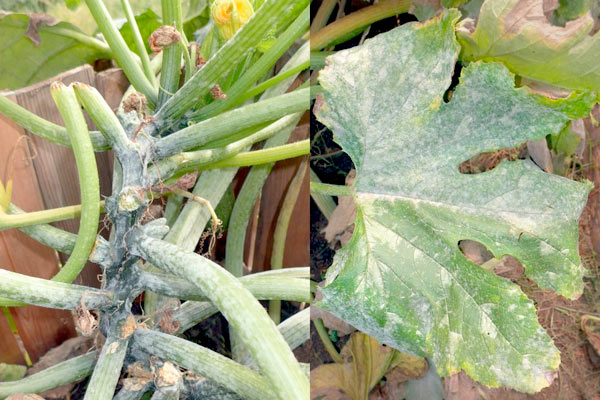
Under the conditions of our country, powdery mildew on cucurbits in cultivation facilities is caused mainly by P. xanthii, while G. cichoracearum is less common and occurs mainly in open fields.
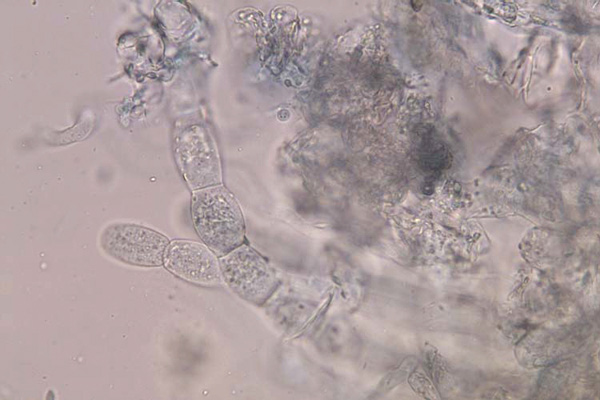
Conidia of powdery mildew on cucurbit plants
When suitable conditions are present and the conidia of the pathogen land on the host, an infectious process is initiated. Upon germination, appressoria develop, from which a specialized hypha attempts to breach the barrier of the host's cell wall to penetrate the epidermal cell, after which haustoria develop and a state of biotrophy is established. Powdery mildew fungi are unique among plant pathogens because they do not need water to infect plants. They develop under dry conditions with high humidity. Their life cycle begins with spores (conidia) that are spread by air currents. As the disease progresses, powdery mildew covers the plant's surface. This leads to a reduction in the photosynthetic surface and weakening of the plant. Powdery mildew can appear throughout the growing season and seriously affect the quality and yield of cucurbits. Symptoms in the form of round, small, white, powdery masses (conidia and mycelium) develop first on the older leaves of the plants. White powdery colonies are sometimes also visible on the stems. The number and size of the colonies later increase, merge, covering a large part of the leaf surface. Severely infected leaves gradually turn yellow and wilt. Later, they dry out.
Powdery mildew on cucumbers
The disease is common on cucumbers of all variety types, grown outdoors and in cultivation facilities, in all production directions. It mainly attacks the leaves and very rarely the petioles and stems. It occurs on both the upper surface of the leaf blade and the lower one. Gradually, the spots enlarge and the leaves look as if dusted with flour. The pathogen overwinters on plant debris and on plants grown in greenhouses. Atmospheric humidity is necessary for the germination of its spores, and to cause infection, the leaves must be slightly wilted. This occurs at high temperatures, when transpiration is intensified, the leaves wilt, and the evaporated water creates a layer around them with humidity around 90%. Temperature and humidity play a significant role in the development of powdery mildew on cucumbers. When high temperatures are combined with high humidity, suitable conditions are created. Besides temperature, light also influences the susceptibility of cucumber plants to the causal pathogen. It has been established that the quality of light can affect the frequency of the disease. The irrigation regime is also important for the development of the pathogen. Watering during the day can increase the likelihood of powdery mildew by 40%. In contrast, allowing the soil to dry out slightly between waterings can reduce this risk. Overhead irrigation through sprinkling is not recommended because it can also be a cause for the appearance of other pathogens. It is best carried out through drip irrigation.
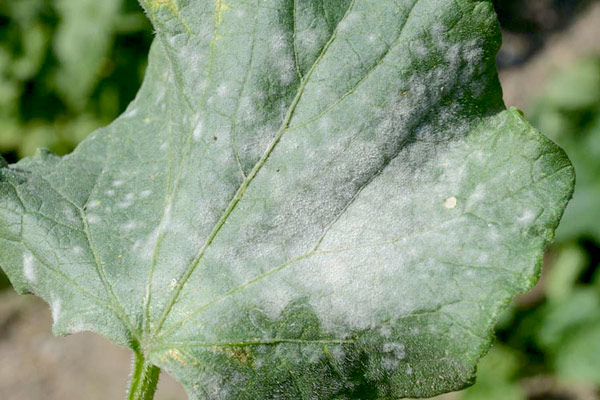
The highest germination rate of powdery mildew conidia (48.52%) was established at a temperature of 25°C and relative humidity of 85%. A temperature range of 25–30°C and relative humidity of 80–90% are suitable for the germination of conidia and the completion of infection. Usually, the disease appears on the leaves about thirty days after planting and develops on the above-ground parts of the plant until harvest if timely control measures are not taken. It has been established that sowing and planting in the second half of August are a prerequisite for stronger attack by the pathogen, while in the first half of July the attack is weakest.
Powdery mildew on melons
Powdery mildew on melons is caused by two species of fungi – Podosphaera xanthii and Golovinomyces cichoracearum. Twenty-eight races of P. xanthii have been identified, with races 1 and 2 being the most common. These fungi overwinter mainly on living plants in warmer regions and spread northward as wind-borne spores during the season. In more northern regions, the disease is usually first detected in mid to late summer. Initially, it manifests as a white, powdery coating on the upper and lower leaf surfaces, as well as on petioles and stems. It develops first on older and shaded leaves. Pale yellow spots may accompany fungal growth. Infected leaves gradually turn yellow and may become brown and papery. Fewer and smaller fruits are formed, and leaf loss can lead to sunscald on the fruits.
Crop rotation is usually not effective for controlling powdery mildew on melons. Nevertheless, it is believed that crop rotation and autumn tillage can delay the onset of epidemics in some regions. Host resistance to both species of powdery mildew is available in some melon varieties.
Powdery mildew on watermelons
This is one of the most common diseases attacking this plant species. The presence of spots on the leaves covered with a white powdery coating is the most common sign. Although the pathogen causing the disease does not attack the fruits, the damage it inflicts on the leaves also affects them. The leaves can be severely affected and dry out. This leads to a reduction in the number and size of formed fruits, as well as the appearance of sunscald on them, due to reduced coverage.
The conditions that favor infection and increase the likelihood of its spread are heat, shade, and moisture. Lack of air circulation and the presence of shade around and between plants stimulate infection. Therefore, planting schemes need to include sufficient space, which will help limit the attack. There are no resistant varieties, so prevention is very important.
Powdery mildew on courgettes
Powdery mildew on courgettes is caused mainly by Podosphaera xanthii. The fungus spreads through wind-borne spores, prefers dry leaves and moderate humidity (40–60%). Temperature is an important factor for its development. It infects in the temperature range of 15–30°C, high humidity, and poor air circulation. The presence of a water droplet on the leaf surface is not necessary for infecting plants. Therefore, it is most common in late summer when nights are cool and days are still warm – in late July and August.
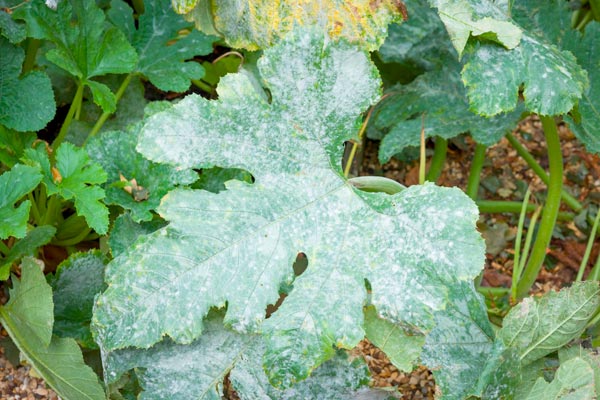
The first signs are small, barely noticeable white spots that appear on the upper surface of the leaves. They look like fine white powder, such as talc or flour, sprinkled on them. The spots quickly merge and cover the entire leaf surface within a few days. As the infection progresses, a yellow halo appears around the white spots. Severely infected leaves gradually darken and die. A white coating of mycelium and spores of the pathogen may appear on the fruits. Attacked and weakened plants produce fewer and fewer fruits. Some may even stop flowering if the attack is severe. The fungus completes its life cycle quickly. From the spores landing on the leaves to the formation of new spores takes only 5–7 days. The short cycle is the reason why untreated powdery mildew quickly gets out of control.
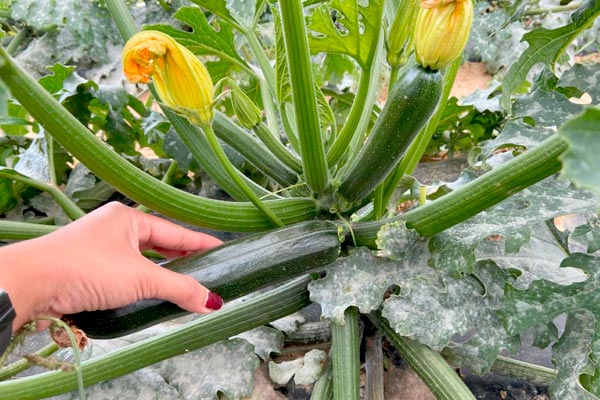
Prerequisites for severe powdery mildew attack on courgettes are several special conditions. These are:
- Crop density. If plants overlap and leaves touch, air passes with difficulty between them. Moisture is retained and creates favorable conditions for spore germination;
- Sprinkler irrigation. When spraying the leaves with water from above, higher humidity is created around the leaves. Although powdery mildew prefers drier leaves, the humid atmosphere created around them is a suitable place for reproduction;
- Different courgette varieties have different sensitivity to the pathogen. Some are more resistant, while others are more sensitive;
- Stressed plants are more vulnerable. When subjected to irregular watering, unbalanced fertilization, planted in poor soil, or affected by other pests, they are more easily infected with powdery mildew.
Prevention strategies: Planting at optimal density; Regular pruning of lower leaves. Pruning is done when the leaves are dry; Watering at the base of the plants, preferably through drip irrigation. Morning watering allows the leaves to dry quickly from the sun; Growing resistant varieties. Such are now available on the market; Mulching with wood mulch around the plants. It maintains soil moisture and reduces plant stress; Balanced fertilization; Regular inspection of the crop for early detection of the attack. This will allow treatment of the crop at the appearance of the first, single spots and successful implementation of control.
Powdery mildew on pumpkins
Powdery mildew on pumpkins (Cucurbita moschata and C. maxima) is caused mainly by the fungi Podosphaera xanthii and Golovinomyces cichoracearum. Research shows that different isolates of these fungi can vary in virulence and aggressiveness, affecting the growth and yield of pumpkin plants. The first signs are the appearance of a white, powdery coating of mycelium and spores on the surface of leaves, petioles, and stems. It develops first on the lower surface of the most shaded lower leaves. On the upper surface of such leaves, opposite the powdery mildew colonies, yellow spots may appear. Older plants are affected first. Infected leaves usually wilt and die. Powdery mildew develops rapidly under favorable conditions because the interval between infection and symptom appearance is short, and a large number of conidia can be formed in a short time. Favorable conditions include dense planting and low light intensity. Field plants are often not affected until the beginning of fruiting.
Impact of climate change
Climate change, especially increased CO2 levels and rising temperatures, significantly influences the development of powdery mildew and the susceptibility of cucurbit plants. With increased CO2, physiological changes occur in plants – the density of stomata and trichomes increases, the intensity of photosynthesis changes, and the levels of salicylic acid and phenolic compounds decrease. These changes can compromise the plants' defense mechanisms against the fungus. A high level of CO2 (500–600 ppm) stimulates plant growth, but also enhances fungal colonization, increasing the number of conidia per unit leaf area and accelerating disease progression. The increase in temperature combined with elevated CO2 exacerbates the severity of powdery mildew, as observed in courgettes and other cucurbit plants. Extreme climatic conditions, including drought, heat, and UV-B radiation, further stress cucurbit plants, reducing their resistance and making them more vulnerable to the pathogen.

Management strategies
Controlling powdery mildew requires the application of a combination of preventive and reactive strategies aimed at the different stages of the disease.
Cultural controls. They are crucial for preventing and managing powdery mildew on cucurbits. One of the most common but also most effective methods is the introduction of crop rotation. Changing the host to a non-host leads to interruption of the disease cycle and reduction of the risk of infection.
Proper sanitation is another essential cultural control measure. Cleaning all plant debris, weeds, and infected plants from the areas will limit the spread of spores. This includes cleaning and disposing of infected leaves, stems, and fruits, as well as cleaning tools, pruning shears, etc.
Pruning can also help deal with powdery mildew. Removing infected areas and cleaning the lower leaves improves air circulation around the plants. Removing all severely infected leaves or branches can prevent the spread of the disease. It requires disinfecting tools between cuts to prevent re-infection. Applying these measures can significantly reduce the risk of powdery mildew infection and create a healthier environment for cucurbit plants.
Chemical control. Chemical control is an effective way to deal with the disease, but it is important to use it carefully. Plant protection products (PPPs) work by directly killing fungal spores or hindering their ability to infect plants. They are contact and systemic. Contact products cover the leaf surface and prevent spore germination. Systemic ones are absorbed by the plant and act from within to prevent fungal growth. The use of chemical control has the advantage that it quickly reduces the frequency and intensity of the disease and is effective for managing large-scale infestations. There are also disadvantages to consider: fungicides can harm beneficial organisms; contribute to environmental pollution; can cause resistance problems. To minimize these risks, it is essential to use PPPs that are part of an integrated pest management (IPM) strategy. This includes rotation of different types of PPPs, monitoring of resistance development. The choice of PPP is determined by the degree of infestation, the stage of plant development, as well as potential ecological impacts. Prophylactic treatment with chemical PPPs against powdery mildew is usually not carried out. It is done at the appearance of the first spots. Treatment with chemical PPPs may be necessary even for varieties that have some resistance to powdery mildew. Treatment should begin when the disease is first detected in the region. Fungicides must reach the underside of the lowest leaves. Sprayers should be adjusted for maximum coverage. Systemic, translaminar, or volatile fungicides should be applied. There are enough registered PPPs against powdery mildew. However, resistance to some groups has been registered. When using fungicides with a higher risk of resistance, rotation of such from different functional groups should be introduced.
Registered PPPs: Vivando 20 ml/decare; Dagonis 60 ml/decare; Diagonal 80 ml/decare; Domark 10 EC 50 ml/decare; Eminent 125 ME 40 ml/decare; Zoxis 250 SC 64-80 ml/decare; Carbicure 300 g/decare; Kozavet 500 g/decare; Kolis SC 40-50 ml/decare; Cumulus 750 g/decare; Custodia 320 SC 50-100 ml/decare; Legado 80 ml/decare; Limocide 200 ml/decare; Neodif 50 ml/decare; Norios 250 SC 64-80 ml/decare; Ortiva Top SC 100 ml/decare; Polyversum 10-30 g/decare; Pousis 750 ml/decare; Prev-Gold 160-600 ml/decare; Rivior 40 ml/decare; Sivar 80 ml/decare; Sinala 160-600 ml/decare; Score 250 EC 0.05%; Sonata SC 500-1000 ml/decare; Sulgran 500 g/decare; Sulfolac 80 WG 300 g/decare; Sulfur WG 300 g/decare; Taegro 18.5-37.0 g/decare; Thiovit Jet 80 WG 300 g/decare; Topaz 100 EC 35-50 ml/100 l; Trezin/Trunfo 80 ml/decare; Fytosev 200 ml/decare; Flint Max 75 WG 20 g/decare; Flosul 750 ml/decare; Fontelis 240 ml/decare; Fungisei 300 ml/decare; Cideli Top 100 ml/decare.
Organic and integrated pest management (IPM) approaches. Organic and integrated pest management techniques can be very effective for controlling powdery mildew on cucurbit plants without harming the environment. They include bioagents, biopesticides, mineral oils, and other non-chemical control means. Their selection is determined by the specific situation – plant species, degree of infestation, climatic conditions, etc.
The long-term prevention strategy requires the application of a multifaceted approach – selection and cultivation of resistant varieties; maintaining optimal soil health, related to stimulating microbial populations, adding organic amendments such as compost or organic fertilizers, avoiding excessive nitrogen fertilization, which can promote lush growth, regularly analyzing the soil to identify deficiencies or excesses of nutrients, pH imbalances that can contribute to the development of powdery mildew. Incorporating integrated pest management (IPM) techniques is another important component of long-term powdery mildew prevention. It involves combining physical, cultural, biological, and chemical controls to manage pests and diseases. For example, maintaining good hygiene, cutting out infected areas, and using crop rotation can help reduce the risk of powdery mildew spread.
Powdery mildew remains the main limiting factor for cucurbit production worldwide, and climate change will likely increase its spread and economic importance. Understanding the interactions between elevated CO₂ levels, temperature, and plant physiology is crucial for developing resistant cucurbit varieties and effective integrated disease management strategies to maintain productivity in a changing climate.
Literature
Bahariev D., B. Velev, S. Stefanov, E. Loginova, 1992. Diseases, Weeds and Pests of Vegetable Crops, Zemizdat.
Smiti, K., U. Mina, M. Verma et al. Impact of climate extremes and other key abiotic stresses on cucurbits: a systematic review. Vegetos (2025).
Nie, J., Q. Yuan, W. Zhang, J. Pan, 2023. Genetics, resistance mechanism, and breeding of powdery mildew resistance in cucumbers (Cucumis sativus L.), V. 9, I. 4, 603-615.
Naik, P. H., S. Kulkarni, 2018. Studies on Epidemiology and Disease Development of Cucumber Powdery Mildew, Int. J. Pure App. Biosci. 6 (3): 483-489.
'