

![MultipartFile resource [file]](/assets/img/articles/заглавна-арония.jpg)
![MultipartFile resource [file]](/assets/img/articles/плантация-арония.jpg)
Economic Importance and Biochemical Composition, Medicinal Properties and Use of the Fruits
Chokeberry is a promising, profitable crop with versatile uses that deserves wider cultivation in the country. The plant (Aronia melanocarpa) belongs to the family Rosaceae, subfamily Pomoideae, genus Aronia. The genus encompasses the species A. melanocarpa Elliot, A. arbutifolia Elliot, A. prunifolia Rehd and their natural hybrids. The species black chokeberry – Aronia melanocarpa Elliot – is of commercial importance. Genetically closest to chokeberry are the species of the genus Sorbus L. – rowan.Chokeberry originates from the eastern parts of North America. It was introduced to Europe first in Germany around 1900, and from there to Russia, where it was initially grown as an ornamental plant.
The most widespread in the world and in our country is the seed form of chokeberry – Aronia melanocarpa, the description of which corresponds to the general characteristics of chokeberry. Cultivars have already been selected worldwide, obtained from black (Aronia melanocarpa), red (Aronia arbutifolia), plum-leaved (Aronia prunifolia) chokeberry and rowan.
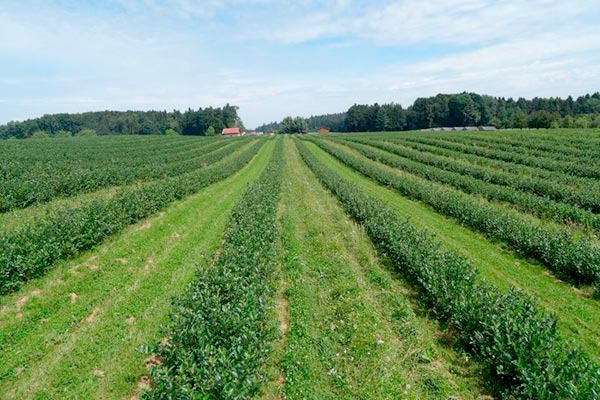
Chokeberry plantation
The commercial distribution of the seed form of chokeberry began after 1946, first in Russia, in the Upper Altai region, and later in Belarus, Moldova, Ukraine and other countries. Michurin (1910) was the first to carry out interspecific crosses Aronia x Sorbus, obtaining the first cultivars „Likernaya“ and „Desertnaya Michurina“.
In Bulgaria, the seed form of chokeberry (Aronia melanocarpa) was introduced in the 1970s from Ukraine, and individual plants before that — by amateur gardeners. Nevertheless, it is a relatively new fruit species.
The generic name of this species derives from the Greek word „aros“, which means help, benefit, defining the usefulness of the plant, and the species name consists of two Greek words: „melanos“ (black) and „karpos“ (fruit), characterizing the coloration of the fruits.
The great interest in it is due to its valuable biological and economic qualities: early bearing, regular and high productivity, cold hardiness, adaptability and others.
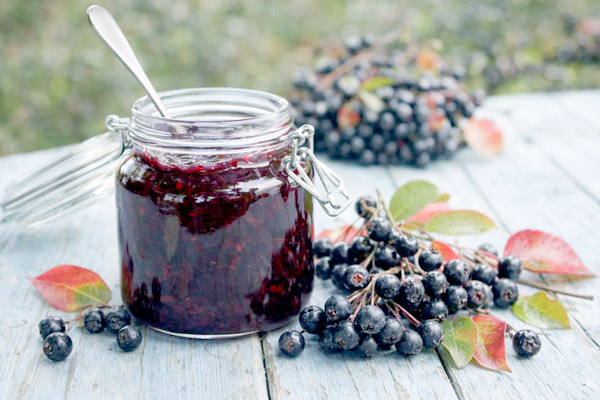
The fruits can be used both fresh and processed. The natural juice is a very good dietary beverage. Its fruits are used in the pharmaceutical industry for the production of medicinal tablets. It is a source of a food colourant harmless to human health. It is also of interest as a honey-bearing and ornamental plant.
The fruits of chokeberry are close in biochemical composition to those of other berry crops. The content of dry matter in the fruits ranges from 17 to 26%, carbohydrates are 7-13%, with monosaccharides predominating, organic acids - 0.7–1.3% and pectin — 0.63–0.75%. The content of tannins is higher — 0.60%, which decrease to 0.35% during storage, which is the reason for the strongly astringent taste of fresh fruits. In terms of vitamin P content (2200 to 4000 mg/%), the fruits of chokeberry surpass all other fruits. The content of vitamin C (60–70 mg/%) and E (0.50–0.80 mg/%) is also relatively high. Of the other vitamins and biologically active compounds, the fruits of chokeberry also contain: vitamin B2 - 0.065–0.17 mg/%, vitamin PP - 0.60–0.80 mg/%, folic acid - up to 0.1 mg/%, catechins - up to 660 mg/%, tocopherols: 2.5–3.2 mg/% and others.
The content of anthocyanins ranges from 420–581 mg/%. It is precisely the anthocyanins that protect against damage to blood vessels, blood and liver and have a tonic effect.
Chokeberry has almost no rival in terms of content of polyphenolic compounds among fruit plants. It is precisely for this reason that they are recommended for the treatment of hypertension, atherosclerosis, capillary toxicosis, kidney inflammation, certain radiation diseases and nervous system disorders. They stimulate appetite, increase the acidity and strength of gastric juice and are therefore particularly beneficial for people suffering from gastritis with reduced acidity, but are contraindicated in gastritis with increased acidity.
The phenolic compounds contained in the fruits of chokeberry increase blood coagulation, which is why they are not recommended for patients with a tendency to thrombosis, thrombophlebitis and people with elevated prothrombin index of the blood. In recent years, however, there have been studies according to which this effect depends on the doses and duration of use of chokeberry preparations. Some believe that in moderate doses chokeberry does not increase, but even slightly lowers the coagulating ability of the blood.
Botanical and Biological Characteristics
Aronia melanocarpa is a perennial deciduous shrub that reaches a height of 2.5–3 m; it is also possible to form it as a tree — on a rootstock of rowan (most often), mountain lemon, hawthorn. It forms numerous suckers, developing into main stems, which under favourable conditions can reach 40–60 in number. They grow from the rhizome and from buds located at the base of the stems. During the first 3–4 years after planting, chokeberry grows slowly and the shrub is compact. After the fourth–fifth year, the shrubs thicken, forming new suckers, branches and twigs.
The root system of chokeberry is shallowly located, which is one of the main reasons for its poor tolerance to heat and drought. It consists of skeletal roots with horizontal and vertical direction. The roots of first and second order have a large number of fibrous rootlets and root hairs. The main mass of roots (85–90%) is located at a depth of 0–25 cm. In the surface layer of 0–10 cm, more than 40% of them are found. The majority are located under the shrub and only 15% extend beyond the projection of the crown.
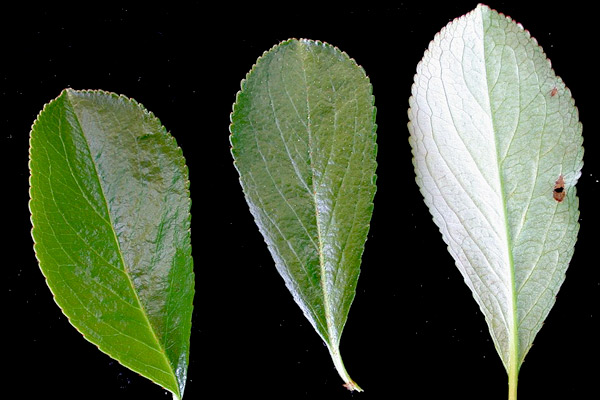
The leaves resemble those of cherry. Simple, entire, finely serrated, broadly ovate, elliptical. Up to 6–7 cm long and up to 4–5 cm wide. At the base of the petiole they have two stipules. They are dark green and glossy, changing colour in autumn to orange-red. This gives the plants great ornamental value.
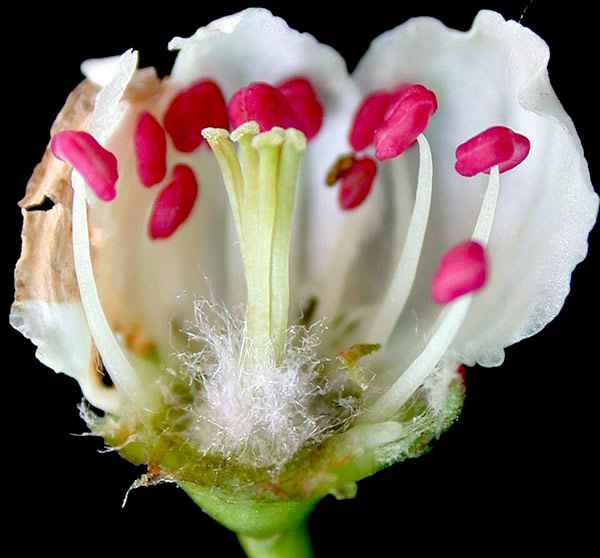
The buds are vegetative and mixed (fruit), and at the base of the stems there are also dormant ones. The vegetative buds are smaller, pointed, elongated and appressed to the branches. The fruit buds are larger, with a more rounded tip. They are located on the apical parts of the branches and their ramifications of different order. From them grows a short twig with several leaves, and at the tip an umbellate inflorescence is formed. The flowers are bisexual, white, small, 10–12 mm in diameter, and beautiful, arranged 15–20 on relatively compact corymbose inflorescences. They have 5 petals, 5 sepals, 8–20 (8–23) stamens and 1 style with stigma. Self-fertility is high, the percentage of fruit set is over 80–90%.
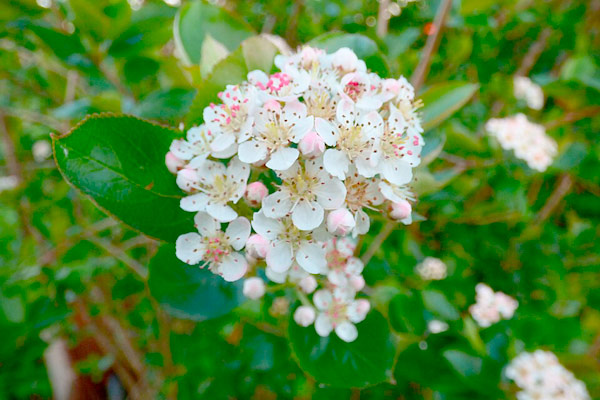
In most regions, flowering begins in early May, when the danger of spring frosts has passed. It continues for about 14–20 days. Depending on the region, the fruits ripen from mid to late August. They ripen quite uniformly, do not drop and retain their freshness for a long time. They can be harvested 7–10 days after ripening.
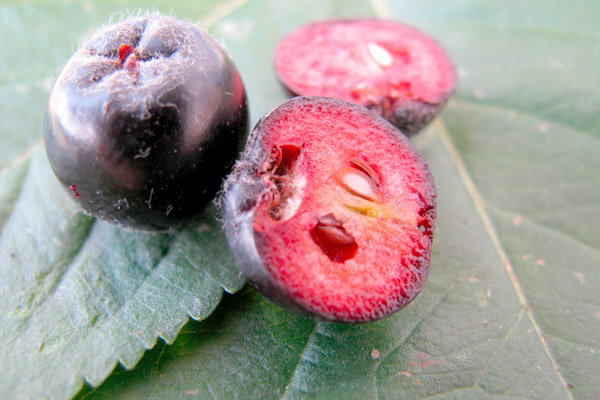
The fruits are small — 0.6–1.5 g — with a rounded shape, black, glossy with a slight greyish bloom. Each fruit contains on average up to 5 seeds. The fruit flesh is greenish, not very juicy, with an astringent taste. Under favourable growing conditions, chokeberry bears fruit regularly and abundantly. From one shrub, up to 2–6 kg of fruits are harvested, and sometimes up to 10–15 kg. The largest fruits are obtained from 3–6-year-old branches. On older ones, fewer mixed buds and smaller fruits are formed. This characteristic is taken into account in pruning.
Requirements for Climatic and Soil Conditions and Cultivar Composition
Chokeberry is a fruit species with great ecological plasticity and can be grown in many regions of the country. Under our climatic conditions, there is no danger of damage to flowers and fruit set from late spring cold spells and frosts.
Most suitable for it are fresh soils with medium mechanical composition, relatively fertile or fertilized with organic and mineral fertilizers, moderately to slightly acidic or with neutral reaction. Unsuitable for cultivation are stony, very heavy, waterlogged and saline soils.
The shallowly located root system, as well as the later ripening of the fruits, determine its great demandingness for soil and air moisture. Where precipitation is less than 650–700 mm per year and if the soil is light and the air humidity in July and August is low, chokeberry cannot be grown successfully without irrigation.
Chokeberry is cold-hardy, tolerating winter frosts down to -30°C. It hardly suffers from spring cold spells and frosts.
The plant can develop and bear fruit even at 1000–1200 m above sea level. Chokeberry is a light-demanding crop and does not tolerate shading. Since with strong thickening of the branches fruiting shifts to the periphery, the yield decreases.
Brief Characteristics of the Most Widespread Cultivars in the World:
Seed form chokeberry
The shrub is medium-tall, up to 2 m, and moderately branched. The leaves are dark green, oval, changing to fiery yellow in autumn. The corymbose clusters consist of 19 fruits, varying from 15 to 27. The fruits are large, with an average weight of 0.86 g; some reach 1–1.2 g. They are black, covered with a waxy bloom, uniform in size, ripen uniformly and do not drop for a long time. The fruits are of universal purpose.
The plants begin vegetation in late March and early April. The appearance of the corymbose inflorescences is around April 15. Flowering occurs around April 30, the mass flowering is on May 9, and the end is on May 21. The ripening of the fruits has a starting date of August 19, and the mass ripening is on August 23. Leaf fall begins on October 15. The average duration of the vegetation period is 195 days.
The seed form is cold-hardy. The plants are relatively resistant to diseases and pests. The chemical composition of the fruits is: 27% dry matter, 9.40% sugars, 1.33% organic acids and 13 mg vitamin C.
Viking
The shrub is medium-growing and tall, 1.5–2.5 m. The leaves are dark green, oval, slightly serrated along the edge, acquiring a purple colour in autumn. The corymbose inflorescences consist of 10–20 flowers.
The fruits ripen in August and September; they are large, 0.9–1.5 g, with dimensions of 12–16 mm, black, with a dark blue tint, glossy, with a flat-rounded shape. The fruits are suitable for technological processing. The cultivar is demanding regarding soil moisture, especially in a dry summer.
Hugin
The shrub is low to medium-tall (0.8–1.5 m), the crown is rounded. The leaves are dark green, glossy, smaller and oval-lanceolate. The corymbose inflorescences are loose but beautiful. The fruits are small (0.4–0.7 g), with dimensions of 6–7 mm. Black, with a purple tint. They ripen in September. In autumn the plants look very spectacular, acquiring a bright red coloration. The cultivar does not tolerate heavy pruning.
Nero
The shrub is tall (1.5–3 m), the crown is compact and resembles that of a vase. The leaves are dark green, oval, becoming dark red in autumn. The cultivar blooms in May. The corymbose inflorescences are very beautiful, formed of white flowers with red stamens. The fruits ripen in August. They are large (1–1.5 g), with dimensions of 12 mm, dark violet, rounded, juicy and aromatic. They are distinguished by a high content of vitamin C and antioxidants. Besides for fruit production, the plants are also very suitable for ornamental landscaping. The cultivar is not very demanding regarding soil conditions. It is resistant to cold, diseases and pests.
Aron
The shrub is medium-tall (1.5–2 m), the crown is compact. The leaves are dark green and oval. The corymbose inflorescences are very beautiful. The fruits are large (1–1.5 g), with dimensions of 10 mm, spherical, dark blue-violet and tasty. In autumn the leaves acquire a beautiful red coloration. Ideal for landscaping gardens and production plantations. The cultivar is resistant to cold, diseases and pests.
Establishment of Plantations and Cultivation of Chokeberry
The choice of areas for planting chokeberry must be consistent with the requirements of the plant. Unsuitable are low, enclosed valley fields, as well as very warm and dry slopes. Most suitable are the high fields in the sub-mountain and mountain regions. Preferred are the sites in the middle and main part of the slopes, with north-northwestern and northeastern exposure. It is desirable to select irrigated areas, but plantations can also be established in regions where more than 750 mm of precipitation falls annually. When establishing commercial plantations, the slope of the area should not be greater than 10–12°.
Of the soil types widespread in our country, suitable are alluvial-meadow, deluvial-meadow and meadow-cinnamon soils. It can also be grown on cinnamon-forest and grey forest soils with a permeable subsoil horizon. On heavy, cold, depleted soils and on those with a shallow gley layer or a high level of groundwater, growth is very weak and fruiting is unsatisfactory. Strongly acidic and alkaline soils are also unsuitable. A mandatory condition when establishing commercial plantations is that the areas be clean of perennial weeds.
The most suitable predecessors are fodder, cereal or leguminous crops grown 2–3 years before planting chokeberry. Preferred are clover, alfalfa, natural and artificial meadows ploughed at least 1 year before planting, as well as some row crops and vegetables. All fruit species are unsuitable because they have diseases in common with chokeberry.
Pre-planting tillage includes basic or current levelling, depending on the terrain relief. Soils with a deep humus horizon over 40 cm are deep-ploughed to a depth of 45–50 cm. Shallower soils, such as grey forest soils, are ploughed to 25–30 cm with a plough equipped with a subsoiler for loosening the subsoil horizon.
Pre-planting fertilization is with 4–5 tonnes/ha of organic fertilizer. It is best done before sowing the predecessor or before the basic tillage, and after it, fertilization is done with 80–100 kg/ha of superphosphate and 25–30 kg/ha of potassium sulphate. The fertilizers are ploughed in to a depth of 20–25 cm. Until planting chokeberry, the area is cultivated 1–2 more times, marked out and the plants are planted. When it is not possible to fertilize the entire area, 5–6 kg of organic fertilizer, 0.100–0.150 kg of superphosphate and 0.025–0.030 kg of potassium sulphate, mixed with soil, are placed in the planting holes.
The optimal planting period is from the second half of October to mid-November. It can also be carried out in late winter or early spring, but before vegetation has begun. The most suitable planting distances for chokeberry are 3–3.5 m between rows and 2–2.5 m within the row. The plants are planted in furrows 20–30 cm deep or in holes measuring 40 by 40 cm. The root collar of the plants should be close to the soil surface. After planting, the soil around the plants is compacted and watered. Pruning is allowed only if the plants are taller than 90 cm.
The first cultivation is carried out in spring with a rotary tiller or cultivator. Within the row, hoeing is done 2–3 times by hand to destroy the weeds. Until the end of the vegetation period, the inter-rows are cultivated 4–5 times, mainly with a cultivator. At a depth of 8–10 cm, the last cultivation is done with a cultivator or disc harrow. Ploughing should not be done, as the shallowly located roots are damaged. An exception is made only when applying fertilizers in autumn, and then every 2–3 years, but at a distance of 50–60 cm from the plants.
In young non-bearing plantations, 9 to 12 kg per decare of nitrogen is applied every year. Half is fertilized in early spring, and the other half — in the phase of intensive growth of the suckers in May–June.
During the vegetation period, it is necessary to carry out more frequent and shallower cultivations while maintaining the soil surface clean of weeds. In this way, favourable conditions are created for the growth and development of the plants. To destroy the weeds, 4–5 cultivations are carried out at a depth of 8–10 cm: in the inter-row and 4–5 cm within the row. The first is in early spring, the second in May, the third in June, the fourth in July and the fifth after harvesting. Every 2–3 years, ploughing is done at 16–18 cm to plough in the organic and mineral fertilizers.
Soil herbicides can also be used to destroy weeds, such as Stomp Aqua (250-300 ml/ha), applied in early spring after soil cultivation. On areas infested with annual and perennial weeds, spraying is done with the herbicides Fusilade Forte 150 EC (80–250 ml/ha) or Agil 100 EC (150–200 ml/ha) in the 3–5 leaf phase of the weeds or at a height of 10–20 cm.
If you do not wish the inter-rows to be in the form of black fallow, you can grass the area with grass mixtures. This is done at the first warming of the weather, after you have fertilized with farmyard and mineral fertilizers. The following mixtures can be used in the following ratio per 1 decare: red clover (1.6 kg seeds) and timothy (1 kg); red clover (1.5 kg) and cocksfoot (1.4 kg); red clover (1-1.2 kg), timothy (0.6 kg) and French ryegrass (0.7 kg); red clover (1.5 kg), Italian ryegrass (1 kg) and timothy (0.6 kg).
Grassed orchards are mowed 3-4 times during the year.
Bearing plants are fed with ammonium nitrate at 7–10 kg/ha 3 times: in early spring, after flowering and during fruit enlargement. Phosphorus and potassium fertilizers are applied to a depth of 16–18 cm every 2–3 years at a dose of 9–12 kg/ha active substance.
With insufficient precipitation in late May and early June, 1–2 irrigations are carried out. In July and August, to maintain the necessary soil moisture of 70% of field capacity, irrigation is done 3–4 times a month with 9–10 l of water per plant.
Chokeberry is thinned every few years. The shrubs are formed during the first 4–5 years. Every year, 5–7 suckers are left, with a view to reaching 25–35 by the 5th year. The best-developed ones, occupying a correct position in the shrub, are selected, and they must in no way be shortened, so as not to thicken the crown excessively. The excess and weak suckers are cut down to the bases. During the fruiting period, only the least productive, aged, broken and unevenly located main branches are removed, and new ones are left in their place. It is recommended that older shrubs – 12-14 years old – be pruned periodically once every 3-4 years. The main rule in pruning is to improve the light regime in the shrub.