

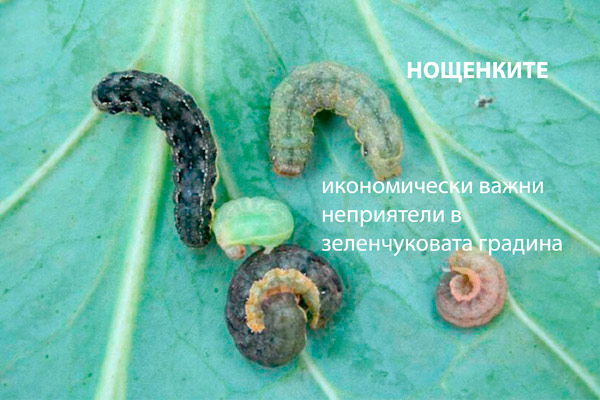
Summary
Noctuids are among the widespread, polyphagous pests. They cause serious losses of production from vegetable crops. Control requires a complex approach that combines prevention, monitoring and timely control. It is necessary to optimally combine the different means in order to achieve maximum efficacy.
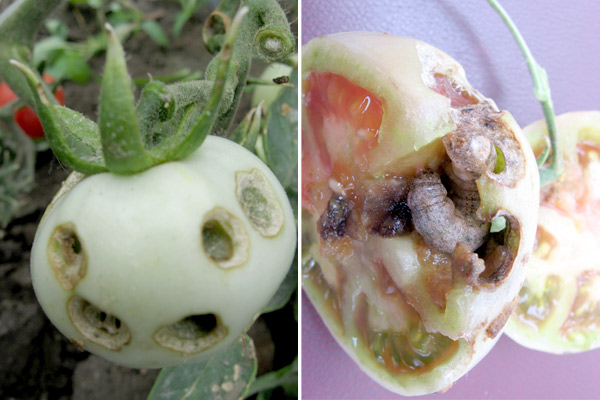
Damage from noctuids on tomatoes
The caterpillars of noctuids feed on a large number of species of cultivated and weed plants, but among vegetable crops they damage: peppers, tomatoes, beans, peas, watermelons, melons, cucumbers, pumpkins, cabbage, potatoes, carrots, lettuce, spinach, turnips, radishes, aubergines, parsley, lettuce and others.
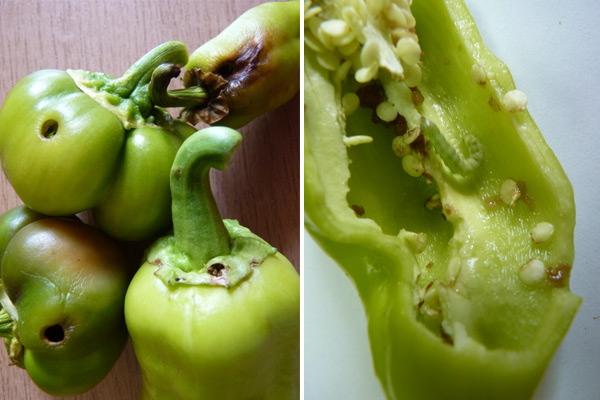
Damage from noctuids on peppers
Above-ground noctuids
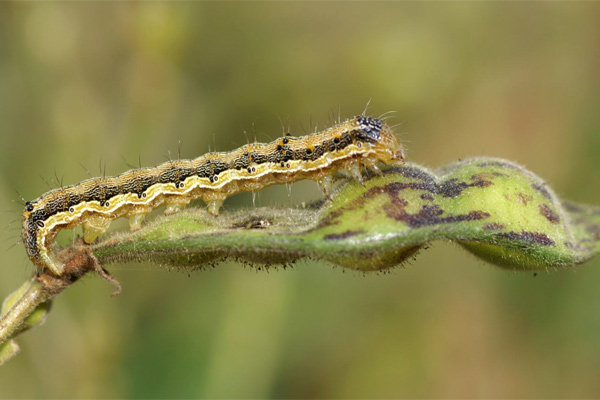
Caterpillar of the cotton bollworm (Helicoverpa armigera Hubn.)
The caterpillars of the cotton bollworm are especially dangerous for mid-early and late tomatoes and for peppers, as they bore into the fruits, enter them, damage them and heavily contaminate them with excrement. Control during this period is difficult, as the caterpillars lead a hidden mode of life and part of the population remains unaffected by the treatments carried out.
The cotton bollworm (Helicoverpa armigera Hubn.) develops three generations per year. In certain years there is also a fourth, which fails to complete its development. It overwinters as a pupa in the soil. The flight of the moths of the first generation begins in May. At night the moths are active, and during the day they hide. The moths of the second generation fly in June, and those of the third – in September. The third generation is the most numerous, but the greatest damage is caused by the caterpillars of the second generation. Embryonic development lasts from 3 to 10 days.
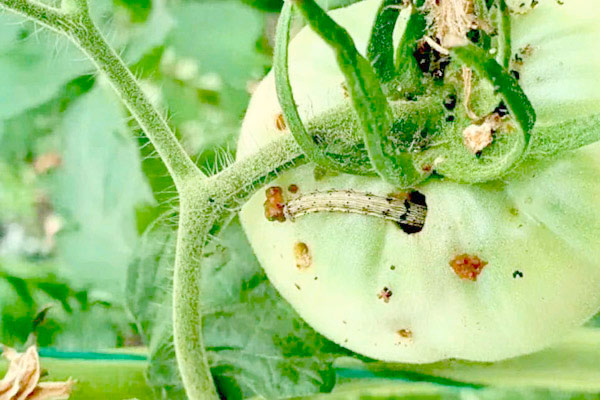
The caterpillars cause damage, which nibble the leaves, buds and flowers, and later attack also the fruits, bore into them and feed on their contents. This damage pattern is often observed in peppers and tomatoes, where the caterpillars enter the fruits often from the stem cavity. The fruits appear perforated with round holes on which there are sometimes excrements. The damaged fruits soften, subsequently watery rot is observed. Usually the caterpillar does not completely destroy the fruit, but leaves it and moves to another. Thus one caterpillar can damage from two to five fruits before completing its development.
The gamma moth (Autographa gamma L.) develops three complete generations and partially a fourth. Outdoors it overwinters as a caterpillar of various instars and as a pupa.
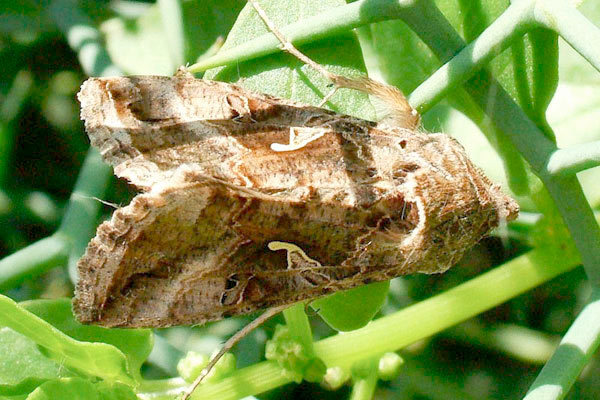
Adult of the gamma moth (Autographa gamma L.)
The moths of the first generation fly in the second ten-day period of April, and those of the fourth until late autumn. The caterpillars of the first and third generations are the most harmful. The adults fly both at night and during the day. The caterpillars feed on the above-ground parts of the plants, preferring the younger leaves. They nibble the periphery of the leaves, and in some cases completely destroy them.
Variegated cutworm (Peridroma saucia Hubner) develops three–four generations per year. It overwinters as a pupa in the soil. The caterpillars lead a nocturnal mode of life. They damage the leaves, making holes of various shapes and sizes. In peppers, after the fruit set forms, they bore into the fruits, making holes at various places. The damaged fruits are unfit for consumption.
Cabbage moth (Mamestra brassicae L.) develops two-three generations per year. It overwinters as a pupa in the soil. The moths of the first generation fly at the end of April - beginning of May. The moths of the second generation fly in the second half of June until the end of July, and those of the third – in the second half of August and the first half of September.
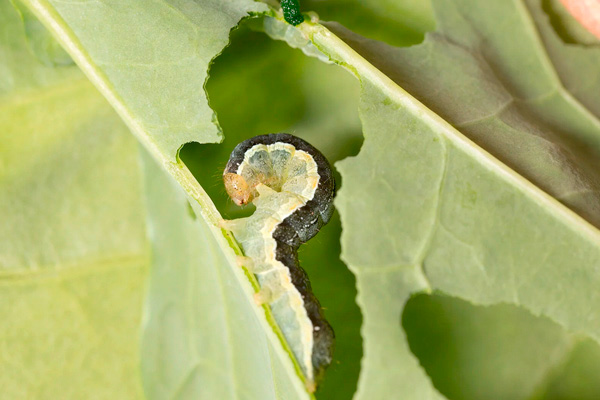
Caterpillar of the cabbage moth (Mamestra brassicae L.)
The caterpillar is coloured depending on age and food – green, brown to black. The development period of the caterpillars is about 25-30 days. In autumn they usually bore into the head of the plant, where they hollow out passages. The food residues and the water that gets into the passages cause rotting and the plant dies. The caterpillars make nibblings on the leaves and the heads. After hatching they live on the underside of the leaves, later they eat the leaves without the thick veins and enter the head. The damaged heads have an unpleasant odour.
Garden moth (Mamestra oleraceae L.) develops two generations per year. It overwinters as a pupa in the soil. The moths fly in the evening. They feed on nectar from flowering vegetation. The females lay their eggs on the underside of the leaves. The caterpillars do not enter the head of the cabbage. They attack the outer leaves and those located close to the soil. Very often the caterpillars bore into the fruits of tomatoes and feed on the fleshy part. They complete their development in 30-40 days. They pupate in the surface soil layer.
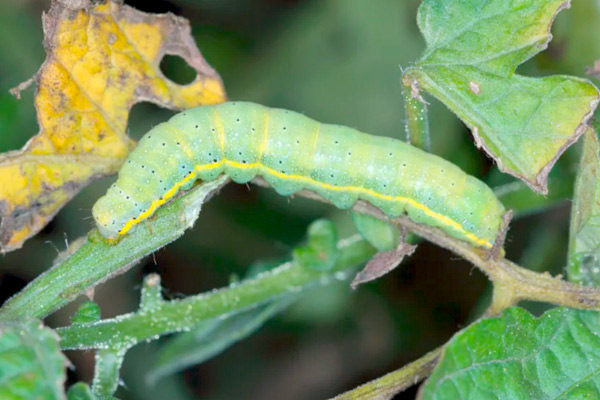
Caterpillar of the garden moth (Mamestra oleraceae L.)
The cabbage moth and the garden moth are close relatives of the below-ground noctuids, but they are not called „cutworms“, because they do not live underground and do not gnaw the stems of the crops. They are representatives of the above-ground noctuids in relation to the mode of life and the damage they cause.
Below-ground noctuids (Cutworms)
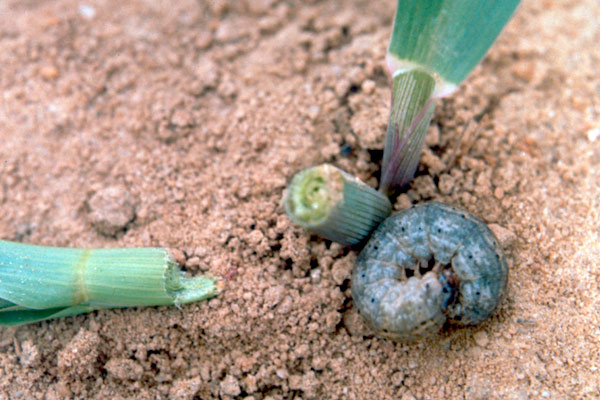
The ipsilon cutworm (Agrotis ypsilon Rott)
These include the winter, the spring and the ipsilon cutworms. The caterpillars are earth-grey to black, smooth, shiny, with a greasy sheen, also called cutworms because of their colouration, they can often be found near the plants, curled up in a “coil”. Damage pattern: the caterpillars gnaw through the plants below the soil surface, feed on the leaf pet