

![MultipartFile resource [file]](/assets/img/articles/заглавна-защита-септември-2026.jpg)
Towards the end of the vegetation period, the development of diseases subsides but does not cease entirely. The density of pests decreases significantly. Many of them have transitioned into inactive stages – pupae and eggs.
The forecast precipitation during the month will increase the risk of development of fungal pathogens on the ripening fruit crop - late brown rot, late scab on the fruits of late varieties of fruit trees, but overall the meteorological conditions during September will limit the development of fungal diseases, with the exception of powdery mildews.
In fruit orchards
Fruit storage facilities are disinfected. This is carried out by a specialist!
To establish the winter population of the codling moth, egg clusters are counted on the trunks and thick branches of 40-60 trees, and for the leopard moth – egg rings on 20 three- and four-year-old branches.
About two weeks before harvest, apple and pear orchards whose fruits are intended for storage are treated with Captan 80 WG (150-180 g/daa) to protect them from late scab and other diseases that develop in fruit storage facilities.
The causal agent of apple scab – the ascomycete fungus Venturia inaequalis (Cooke) Winter, with conidial stage Fusicladium dendriticum (Wallr. & Fuckel) economically the most harmful disease on apple.
It persists in its saprophytic form in damaged fallen leaves overwintering on the soil surface, where after overwintering pseudothecia with ascospores are formed, causing primary infections in spring. They do not mature simultaneously, but over a period of 7-9 weeks, most often during the flowering period.
The maturation and discharge of ascospores occurs only after moistening. Germination of ascospores is possible only in the presence of free water droplets on the plant surface, but the duration of the incubation process depends on temperature – at 7-8 oC it is 17 days, and at 20 oC – only 8 hours.
In case of late infection on already ripening fruits, the symptoms of the disease manifest as relatively small brown-black, sharply delineated spots that continue to develop and enlarge under storage conditions. These lesions are very often the primary cause for intensive development of pathogens typical of the storage period – grey rot, soft rot, Alternaria rot, Trichothecium rot and others.
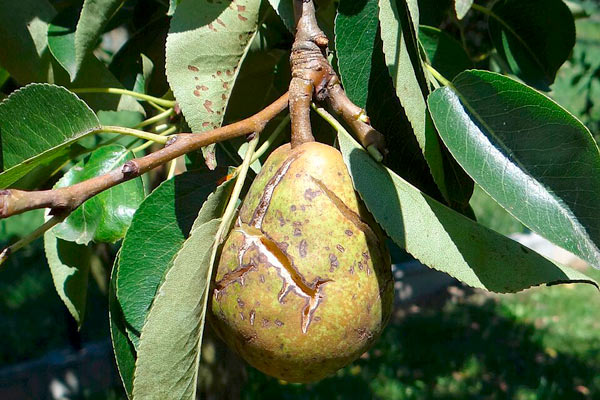
The ascomycete fungus Venturia pyrina (Bref.) Aderhold, with conidial stage Fusicladium pyrinum (Libert) Fuckel, causal agent of pear scab, has a high harmful potential and under conditions favourable for its development can cause very significant economic damage. The pathogen overwinters not only on fallen leaves, where asci with ascospores develop, but also in cankers on shoots.
The development of the disease is favoured during periods with frequent rainfall, prolonged retention of water droplets on plant tissues and moderately high temperatures.
The symptoms of the disease initially manifest as rounded spots covered with a radially developing dark green fungal growth. Later these spots necrotize, forming extensive scorched areas and premature defoliation. Unlike the damage on apple, these spots appear on the underside of the leaves and are more noticeable
To establish the density of the pear bud weevil at the end of the month, shaking is carried out – initially every other day, and after detecting the first insects, daily on 10 trees per 500 decares, distributed sporadically throughout the plantation.
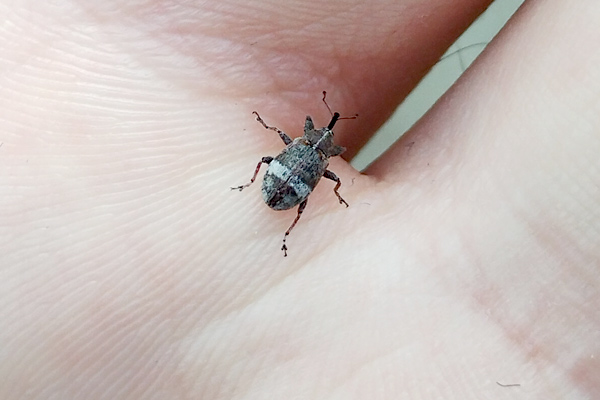
The pear bud weevil (Anthonomus pyri Kollar) attacks mainly pear, and although rarely, also damages apple, apricot, plum. It occurs throughout the country. The weevil develops one generation per year. It overwinters as an egg in the buds of the pear and a small portion as an adult insect.
The beetles are slightly mobile. In September they feed by gnawing the leaf and flower buds in order to reach sexual maturity, after which they lay their eggs. They can destroy more than 40 buds. The females gnaw a channel in the mixed buds and at its bottom lay one egg each. The egg-laying period lasts 1.5-2 months. The average fecundity is 15-20 eggs.
The eggs overwinter and hatch the following year. Some of the beetles remain to overwinter and continue to lay eggs in spring as well.
Chestnut trees are sprayed at the beginning of the month, before egg-laying, with Koragen 20 SC (18-30 ml/daa) or another contact insecticide for control of the chestnut weevil. The spraying is repeated twice more at 7-10 day intervals.
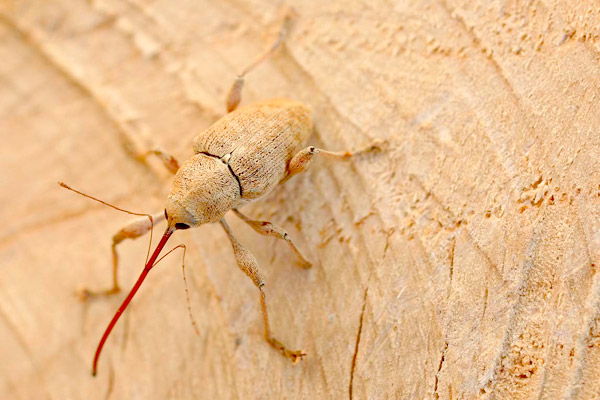
The chestnut weevil – Curculio (Balaninus) elephas Gyll. is widespread everywhere. It damages the cultivated chestnut and oak. It occurs more massively in areas where there are chestnut plantations. The weevil develops one generation per year. It overwinters as a larva in the soil, which pupates in June.
Egg-laying by the beetles begins only in August-September. With the help of their long rostrum, the females deposit 1 to 20 eggs in a single fruit. Embryonic development lasts 2-3 weeks.
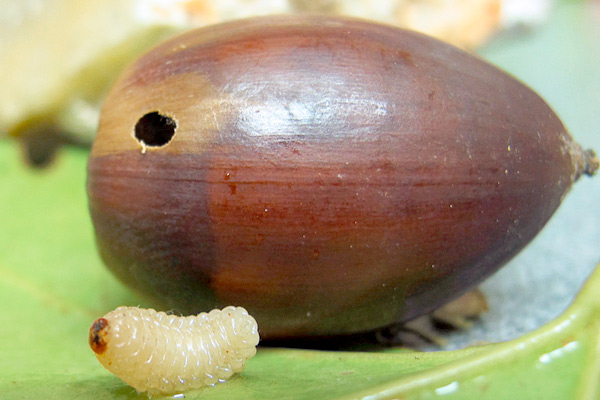
The larvae feed on the interior of the fruits, which become wormy and filled with excrement, gnawed remnants and moulted larval skins. After completing their development, they gnaw a round hole, leave the fruit and go into the soil. There they prepare an earthen cell, at a depth of 7 to 40 cm, but most often about 15-25 cm, and remain in it until June-July of the following year.
In strawberry plantations
Before replanting, for crops clean of weeds, strawberry plantations are treated with Roundup Energy (300-500 ml/daa for annual and biennial weeds and 500-800 ml/daa for perennial ones) or with double sowing of cover crops, done the previous year – spring (50 % oats + 25 % peas + 15 % vetch + 5 % phacelia + 5 % mustard) and autumn (60 % winter rye + 25 % hairy vetch + 10 % crimson clover + 5 % fodder radish).
Strawberry plantations are irrigated with one of the insecticides - Decis 100 EC (17.5 ml/daa) or another based on deltamethrin, Mospilan 20 SP (30 g/daa), Naturalis (300 ml/daa) until the soil is moistened to a depth of 15 cm against the larvae of root weevils.
The strawberry root weevil (Otiorhynchus rugosostriatus), the Turkish vine weevil (Otiorhynchus turca), the small vine weevil (Otiorhynchus sulcatus) and the alfalfa root weevil (Otiorhynchus ligustici) cause damage. The larvae of these weevils feed on the roots of the strawberry.
Strawberry Planting Material – Clean from Diseases and Pests
Strawberry planting material is inspected for diseases and pests that are transmitted with it – white and violet-brown leaf spots, root weevils, strawberry nematode, strawberry mite, viral diseases, etc.
Strawberry planting material is disinfected if infested by strawberry mite or strawberry nematode, by dipping for 13-15 minutes in water at a temperature of 45-50 oC.
In vineyards
The control against downy mildew in vine nurseries continues. After sporulation of the pathogen, treatment is carried out with one of the preparations - Quadris 25 SC – 0.075 – 0.1 %, Ridomil Gold Combi 45 WG – 200 g/daa, Ridomil Gold R WG – 500 g/daa, Ridomil Gold SL – 20 ml/daa. Serenade ASO is also an option, but acts more weakly than the systemic fungicides listed. Before rain, since the listed fungicides are not systemic, you can use some copper preparation - 1 % Bordeaux – 180 - 300 g/daa solution, Funguran OH 50 WP – 150 - 250 g/daa, Champion WP - 0.3 %, Kaper Key – 180 - 300 g/daa.
During the month of September, serious attention must be paid to the control of grey rot.
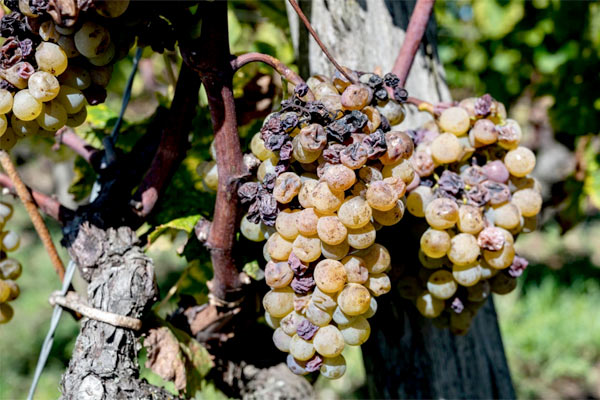
The causal agent of the disease is the fungus Sclerotinia fuckeliana, with conidial form Botrytis cinerea Persoon f.sp. vitis. In rainy weather it causes significant damage to grapes. It develops much more strongly on cracked berries after rainfall, during berry softening and at harvest. On all affected sites, an abundant grey-white growth with a slight brownish tint is formed. Very often in wet weather, grey rot also appears during the transport and storage of grapes.
The disease develops at temperatures from 0 to 31 oC, with the optimal temperature being 25 oC. Conidiospores are formed at air humidity above 60 %, and germinate at above 50 %. Infection occurs even without the presence of water droplets on the plant parts of the vine - 60 % air humidity is sufficient. Under favourable conditions, the incubation period of the fungus is from 2.5 to 3 days.
The timely implementation of certain agrotechnical measures, such as defoliation, shoot thinning, desuckering, as well as the correct spatial arrangement of the fruiting units with a view to ensuring good ventilation of the grapes, limit the disease.
Treat with some of the preparations – Switch 62.5 WG (100 g/daa), Folpan 80 WDG (0.15 %) or another preparation with active substance folpet. Among the biofungicides, Polyversum (50-100 g/daa) and Serenade ASO SC (400 ml/daa) are recommended.