

Abstract
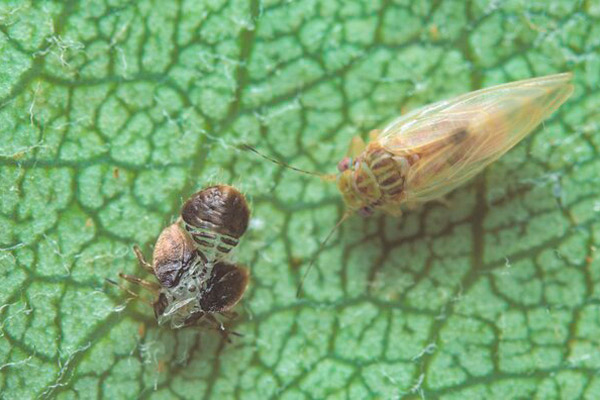
The pear psylla (Cacopsylla pyri L.) is among the economically most significant phytophagous species on pear in Europe. Its widespread distribution, high reproductive potential and ability to develop multiple generations during the growing season determine its high harmfulness and economic importance. The damage caused by the pest includes both direct physiological disorders resulting from the feeding activity of nymphs and adults, and indirect effects related to the excretion of honeydew and the development of sooty moulds. Under conditions of climate change and increasing restrictions on the use of plant protection products, the need for in-depth knowledge of the biology, phenology and ecology of the species is growing. The present review summarizes current scientific knowledge on the taxonomy, morphology, life cycle, seasonal dynamics and economic importance of C. pyri and examines their application in the development of modern integrated plant protection strategies.
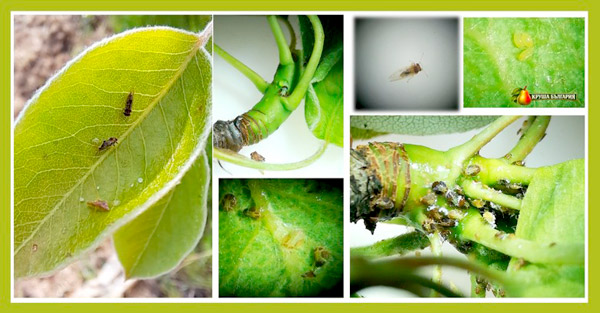
The pear (Pyrus communis L.) is among the leading pome fruit species in Europe, and sustainable production of quality fruit depends to a significant extent on the effective management of diseases and pests. Among the economically significant pests of the crop, the pear psylla Cacopsylla pyri L. occupies a leading position due to its widespread distribution in the main pear-producing regions and its ability to form populations of high density that can have a substantial impact on productivity and yield quality.
The harmfulness of C. pyri is determined by the feeding activity of nymphs and adults, the high reproductive potential and the development of several generations during the growing season. The population dynamics of the species depend on the interaction between climatic conditions, the phenological development of host plants and the applied plant protection strategies, which complicates the sustainable management of the pest.
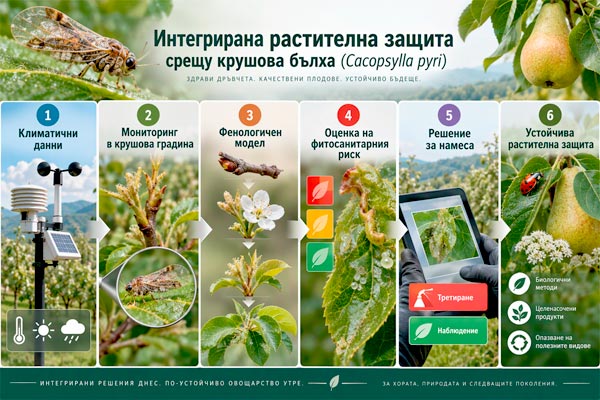
The modern concept of integrated plant protection places emphasis on knowledge of the biological and ecological mechanisms determining the development of pests in agroecosystems. In the case of C. pyri this is of practical importance for improving monitoring, tracking population dynamics and determining appropriate timing for the application of control measures.
Taxonomic position and distribution
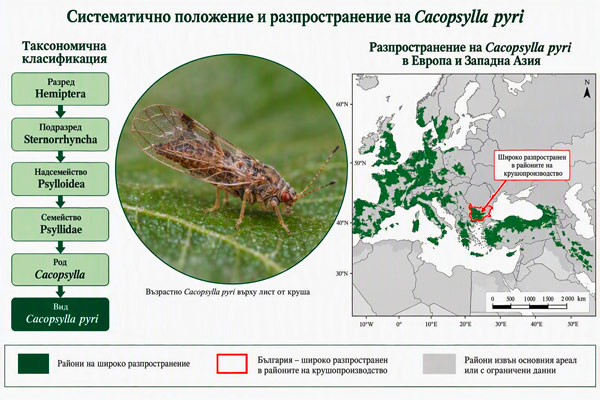
Cacopsylla pyri L. belongs to the order Hemiptera, suborder Sternorrhyncha, superfamily Psylloidea and family Psyllidae. The genus Cacopsylla includes a considerable number of phytophagous species associated with various woody hosts, some of which are of significant economic importance.
Among the representatives of the genus associated with pear, the greatest practical importance is attributed to Cacopsylla pyri, Cacopsylla pyricola and Cacopsylla pyrisuga. In most European pear-producing regions C. pyri is the dominant species and a major phytosanitary problem, which is why it is subject to intensive monitoring and management.
The distribution range of the species largely corresponds to the areas of cultivated pear growing. C. pyri is widespread in Southern, Western and Central Europe and occurs in a number of regions of Western Asia. In Bulgaria, the species is established throughout the areas of commercial and amateur pear production, where it is among the most common and economically significant pests.
Morphological characteristics
The life cycle of Cacopsylla pyri includes the egg stage, five nymphal instars and the adult insect (imago). The individual stages are distinguished by specific morphological and biological characteristics that determine their importance for population development, the spread of the species and the formation of its harmfulness. These features are of practical importance for the identification of the species and the tracking of its population development in fruit orchards.
Table 1. Main morphological features and biological significance of the individual stages of development of Cacopsylla pyri L.
| Stage | Characteristics | Significance |
| Egg | Elongated, yellow to orange, attached by a stalk | Beginning of the development of the new generation |
| Nymph instar I-II | Light yellow, with a dorso-ventrally flattened body | Initial feeding |
| Nymph instar III-IV | Gradually increasing size and developed wing buds | Intensive feeding and honeydew excretion |
| Adult insect (imago) | Well-developed wings and hind legs | Dispersal and reproduction |
Biology and life cycle
The development of Cacopsylla pyri is closely linked to the phenology of the host plants and to the temperature regime of the environment.
The species overwinters as an adult insect (imago), which survives the unfavourable season in sheltered microhabitats, including the cracked bark of trees. Seasonal differences in colouration and physiological state related to reproductive activity and overwintering are observed in the adult forms. With the onset of suitable temperature conditions in late winter and early spring, the adults resume their reproductive activity, and oviposition begins before or at the start of pear vegetation. Eggs are laid on buds, young leaves, flowers and actively growing shoots. After hatching, the nymphs develop on the young plant organs, where they feed actively and excrete honeydew.
The duration of development depends strongly on temperature. Under warmer conditions, the life cycle is shortened and the number of generations increases. Under the conditions of Southern Europe, several generations per year can develop, which is one of the main reasons for the difficult control of the pest.
The population density of C. pyri usually increases gradually during spring and reaches maximum values during the summer months. This seasonal dynamics is determined by the favourable temperature conditions and the availability of young plant organs that provide a suitable food resource for the development and reproduction of the pest.
Relationship between pear phenology and the development of the pear psylla
The development of Cacopsylla pyri is closely synchronized with the phenological development of the host plants. The life cycle of the species is evolutionarily adapted to the periods of formation of young plant organs that provide optimal conditions for feeding, development and reproduction of the pest. The correspondences between the phenological phases of pear and the development of C. pyri indicated in the table are indicative. The timing of appearance and duration of the individual stages, as well as the dynamics of population density, are influenced by the temperature conditions and the course of vegetation during the respective year. Therefore, the development of the pest does not follow a strictly defined sequence tied to specific BBCH phases. Taking these features into account is important for the correct tracking of population dynamics and the determination of appropriate timing for monitoring and control.
Table 2. Synchronization between the phenological development of pear and the life cycle of Cacopsylla pyri L.
| BBCH phase | Phenological development of pear | Development of C. pyri |
| 00-01 | Dormancy | Overwintering adults |
| 01-09 | Bud swelling | Resumption of reproductive activity and onset of oviposition |
| 10-19 | Bud break | Hatching of the first nymphs |
| 51-59 | Budding | Development and feeding of nymphs; possible increase in population density |
| 60-69 | Flowering | Continued development of nymphs and appearance of new eggs depending on conditions |
| 71-79 | Fruit set and development | Presence of nymphs and adults |
| 81-89 | Fruit growth | Possible development of successive summer generations |
The close relationship between the phenological development of the host plants and the seasonal dynamics of C. pyri is of key importance for phenological forecasting and provides a scientific basis for optimizing monitoring and determining economically justified timing for the application of control measures.
Economic importance and nature of damage
The economic importance of Cacopsylla pyri is determined by the complex impact of the pest on plant productivity and the quality characteristics of the yield. The harmfulness of the species is a result of both the direct damage caused by the feeding activity of nymphs and adults and the indirect physiological and economic consequences related to the disruption of the normal functioning of the plants and the deterioration of the commercial qualities of the produce. Therefore, in many European countries C. pyri is defined as one of the economically most significant pests on pear and an important phytosanitary factor limiting sustainable pear production.
The harmful activity of C. pyri is determined to a significant extent by the population density and the duration of impact on the host plants. The multivoltine nature of the species and the development of several successive generations during the growing season favour the progressive increase in population numbers and the increase of its harmful potential. According to Civolani et al. (2023) C. pyri is characterized by high biological plasticity, considerable reproductive potential and the ability to rapidly colonize suitable food resources, which represents one of the main factors complicating the sustainable management of the pest.
Direct damage is caused by both the nymphs and the adult insects. During feeding, they pierce the plant tissues with the stylets of their mouthparts and extract phloem sap. Prolonged feeding leads to disruption of physiological processes, reduction of photosynthesis intensity and weakening of the overall condition of the trees. At high pest density, leaf deformations, suppressed shoot growth and impaired development of young fruits can be observed. Young trees and orchards with intensive vegetative growth are particularly sensitive, where prolonged infestation can lead to a significant limitation of growth.
The indirect damage caused by C. pyri often has greater economic importance than the direct damage related to the feeding activity of the pest. During their development, the nymphs excrete significant amounts of honeydew, which accumulates on leaves, shoots and fruits. These deposits create favourable conditions for the development of sooty moulds and the formation of a characteristic dark coating on the surface of the infested organs. Although these microorganisms do not penetrate the plant tissues, their development on the leaf surface can limit light access and reduce photosynthetic activity, while the coatings on the fruits deteriorate their appearance and commercial qualities.
From an economic point of view, the indirect damage related to the accumulation of honeydew and the development of sooty moulds often determines the real extent of the losses caused by C. pyri. In dessert pear varieties, even surface contamination of the fruits with honeydew and sooty moulds can lower their commercial value, without necessarily a corresponding degree of physiological damage to the tree being present.
Modern research shows that the development and population dynamics of C. pyri are influenced by climatic factors, especially the temperature regime. Temperature conditions can change the duration of development and the dynamics of generations, and their combination with the other environmental factors affects the population numbers and the degree of infestation.
Table 3. Main types of damage caused by Cacopsylla pyri L. and their impact on plants and yield
| Type of damage | Affected organs | Consequences |
| Sucking of plant sap | Leaves, shoots, flowers, fruitlets | Impaired growth and weakening of plants |
| Honeydew excretion | All above-ground organs | Contamination of plants and fruits |
| Development of sooty moulds | Leaves and fruits | Reduced photosynthesis and impaired commercial appearance |
| Prolonged high population density | Whole tree | General weakening and reduced productivity |
The combined action of direct and indirect damage determines the economic importance of Cacopsylla pyri in pear orchards. Effective management of the pest requires systematic observation of its population dynamics, consideration of the phenological development of the host and application of integrated control measures.
Impact of climate change on the population dynamics of Cacopsylla pyri
Climate change is among the main factors influencing the population dynamics of phytophagous species in fruit agroecosystems. Rising temperatures, changes in precipitation regimes and the increasing frequency of extreme climatic events have a substantial impact on the phenology of host plants and the development of pests. Cacopsylla pyri is among the species in which these processes are clearly expressed and directly influence the numbers and harmfulness of populations (Reeves et al., 2024).
Warm winters favour the survival of overwintering adults and lead to the formation of higher initial population density in spring. In addition, climate warming accelerates the resumption of activity after overwintering and shifts reproductive activity towards earlier phenological phases of pear. Elevated temperatures shorten the duration of the life cycle and can lead to the development of additional generations during the growing season, which increases population density and the risk of economically significant damage (Civolani et al., 2023; Reeves et al., 2024; Schaub et al., 2005).
The phenological synchrony between the pest and its natural enemies is also of significant importance. The different response of organisms to temperature changes may lead to a shift in the timing of individual phenological events in C. pyri and the beneficial entomofauna. This may affect the effectiveness of natural biological control, with the direction of change depending on the specific interactions between species (Reeves et al., 2024; Reeves et al., 2025).
The effect of climate change is not limited solely to temperature. Drought and water deficit affect the physiological state of host plants and can create conditions favouring the development and multiplication of the pest. As a result, the probability of reaching high population density and economically significant harmfulness increases (Reeves et al., 2024).
The modern ecosystem approach considers climate change as a factor that simultaneously affects host plants, the pest and its natural regulators. Therefore, effective management of C. pyri requires the integration of monitoring, phenological forecasting and strategies for conserving natural enemies under conditions of a changing environment (Reeves et al., 2024).
Monitoring and forecasting
Modern strategies for the management of Cacopsylla pyri are based on the integrated use of monitoring and phenological forecasting. Unlike calendar-based plant protection schemes, these approaches use information on the biology, phenology and population dynamics of the pest to